Overview
There is a quote from Theodore von Kármán that reads, Scientists discover the world that exists; engineers create the world that never was.
I first saw this quote at MIT and it has stuck with me since. But it was the perfect way to capture the core of our program and engineering education in general — learning by doing.
As an Instructional Designer my role was to create the conditions in which learners could meaningfully practice what they had learned. This translated into prototyping, teaming, and then pitching the idea (rather than presenting it) as if they were selling a new product. All of these were real-world skills that the faculty I partnered with aimed to provide. And so they were my goals too.
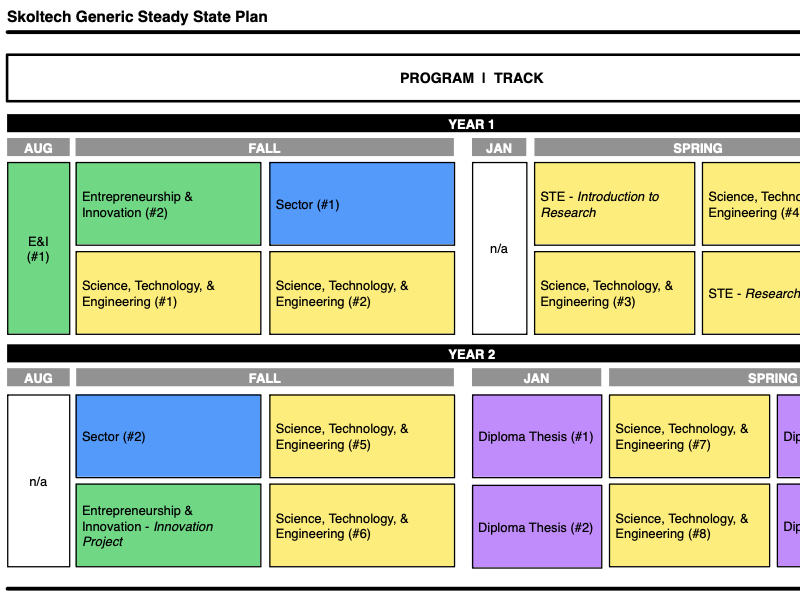
The learning model for the MIT-SKT program was very different from the standard 15-16 week university model. Rather than complete 4 courses during that time, learners would focus on 2 course at a time. Over a standard 16-week semester, learners time would break into the following pattern:
- 6 weeks for 2 courses and learning activities
- 1 week for assessment
- 1 week for application
- 2 day weekend break
- 6 weeks for 2 courses and learning activities
- 1 week for assessment
- 1 week for application
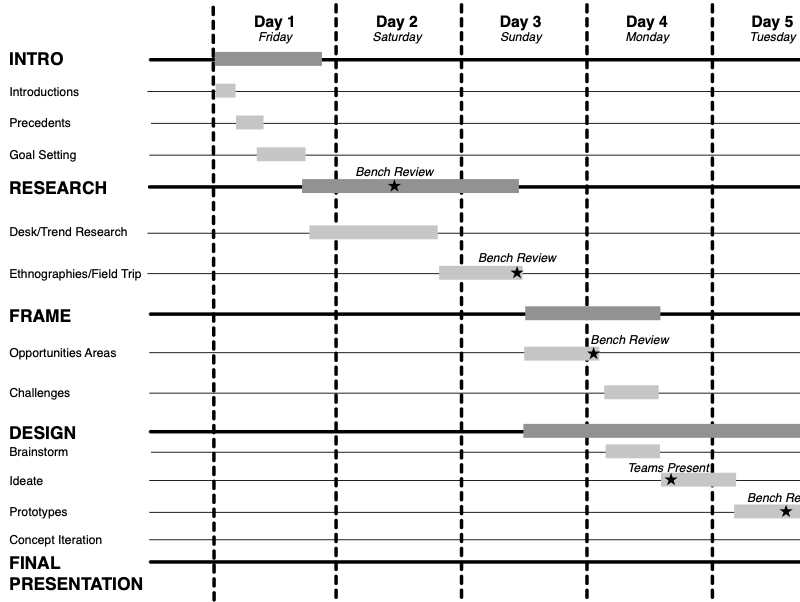
Each Skills Application Period (week) would follow the CDIO learning cycle.
- Conceive — day 1
- Design — days 2-3
- Implement — days 4-6
- Operate — days 6-7
- Celebrate! — day 8
By the end of the semester learners not only applied gained knowledge in their area of study, but they did it in teams, they practiced business skills, and they used cross-domain knowledge from courses in sector experiences.
Artifacts
It is a bit difficult to show the value of an in-person skills application event since it was not designed to have digital artifacts. But the following can help you to understand the weeks of effort that went into planning the event and placement within program tracks. It was a unique activity for all participants, and truly fun for everyone in the room.
Skills Application Period in Context
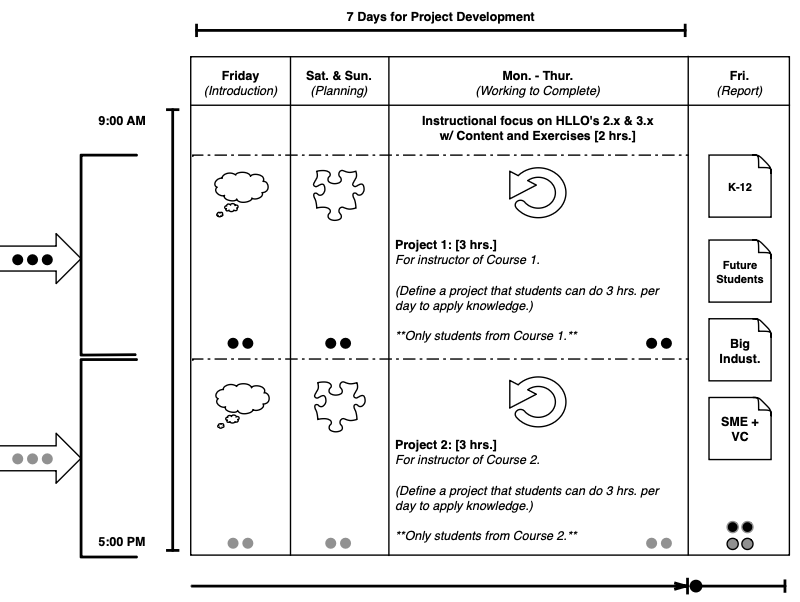
The following documentation shows the context of the hands-on application period. On the left, is the generic model for a program track. There were 2 application periods within a given semester and they involved bringing together knowledge learned while taking two parallel courses. In the center, is some of the guidance I created for the skills application period, including various models we discussed for how to conceptualize running it. And on the right, is the timeline I created with the lead faculty from the MIT Media Lab for how to run the week with a design process at its core.
Skills Application Period 1
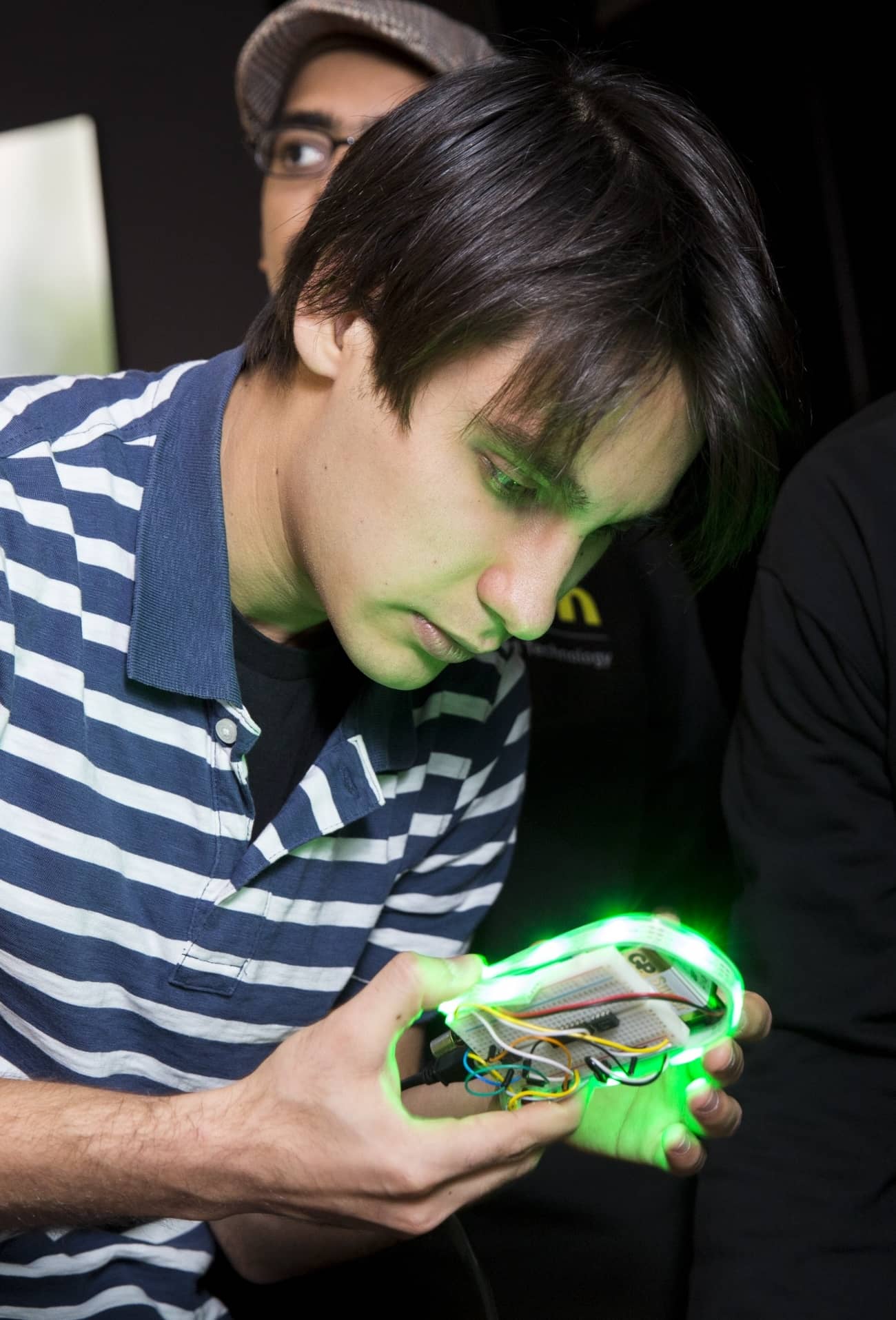
The first skills application period ran during the middle of fall 2013 in Moscow, Russia. My colleagues and I traveled to Skoltech and stayed the week to observe and document how it unfolded. It was nothing less than awesome. The students were highly engaged from the start of the design process, through crafting how they would pitch the concept, incorporate feedback, build a prototype, and then demonstrate its value and sell it to the audience. Of a few hundred images I took, the short video below shows what it was like to be present.
The video consists of 42 photographs with 2 seconds viewing time for each.
Impact
This was the first of its kind event with no precedent. Its impact was in the engagement from faculty, staff, and students. What is more, the prototypes students created and practiced pitching were exactly the kind of evidence we were seeking. The how they did it was something that we knew could always improve and sought to make stronger in iterations that followed. Nonetheless, this event set a solid foundation for the skills application periods to come.
To this day, I am both proud and honored to have been a part of this kind of curricular and activity building at MIT. I think we all felt something special from it. I personally love building and it was great to be able to use the diversity of my knowledge and skills to contribute to building activies like this.